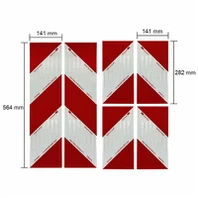
Survey retroreflective targets are essential tools used in land surveying. These targets are used to accurately measure distances and angles between points on the ground, which is critical in various surveying applications.

The retroreflective targets consist of small, reflective components that reflect light back to its source. These components are carefully arranged in a precise geometric pattern, which allows surveyors to make highly accurate measurements from a distance using specialized instruments such as total stations and theodolites. The retroreflective targets are used to increase accuracy, as they help reduce the effect of atmospheric distortion and other factors that can impact survey measurements.
Survey retroreflective targets come in various shapes and sizes, including rods, disks, and crosses. The size and shape of the targets depend on their specific application and the conditions under which they will be used. Some targets are designed to be placed on tripods while others can be easily mounted on walls or other surfaces.

One of the essential features of survey retroreflective targets is their high visibility. The targets are made with highly reflective materials, which make them visible even in low light conditions. This feature is essential for surveying work, which often takes place during early morning or late evening hours when lighting conditions are less than ideal.
The use of survey retroreflective targets has revolutionized the field of land surveying, making it possible for surveyors to make highly accurate measurements over long distances. These targets have become an indispensable tool in the work of surveyors, engineers, and other professionals who require precise measurements for their work.

Survey retroreflective targets play a critical role in land surveying, providing highly accurate measurement data that is essential for various applications. These targets offer high visibility, durability, and are available in a range of shapes and sizes. With the help of these targets, surveyors can produce reliable, accurate data that is vital in the planning and execution of construction projects.