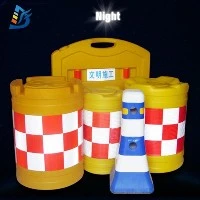
Complete Guide to Reflective Sheeting for Crash Barrels: Material Classification & Selection Guide
1. Introduction: The Dual Safety Role of Crash Barrels
Road safety infrastructure plays a vital role in minimizing traffic accidents and saving lives. Among various traffic control devices, traffic crash barrels (also known as impact attenuators, water/sand-filled crash cushions, or safety barrier drums) are widely deployed across highways, construction work zones, toll plazas, diverging ramps (gore areas), bridge piers, and residential entrances.
Dual Protection Mechanism:
- Physical Impact Mitigation (Kinetic Energy Absorption): When filled with water or fine sand, crash barrels create a progressive deceleration buffer. In the event of a vehicle collision, the mass and fluid displacement absorb and dissipate kinetic energy, significantly reducing impact force on vehicle occupants.
- Visual Warning & Optical Guidance (Passive Safety): Physical impact absorption is the last line of defense; preventing the collision entirely is the primary objective. Crash barrels wrapped with high-performance retroreflective sheeting (reflective tape/film) return headlight beams directly to the driver's eye-line, making obstacles clearly visible hundreds of meters away at night or during adverse weather (heavy rain, fog, snow).
Therefore, a crash barrel functions not only as a structural impact barrier but also as an indispensable high-visibility warning device.
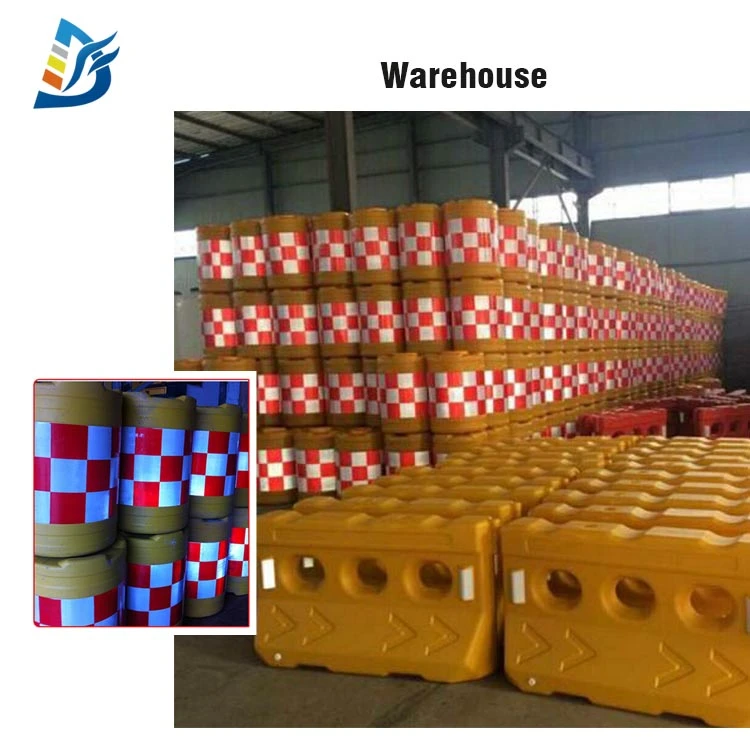
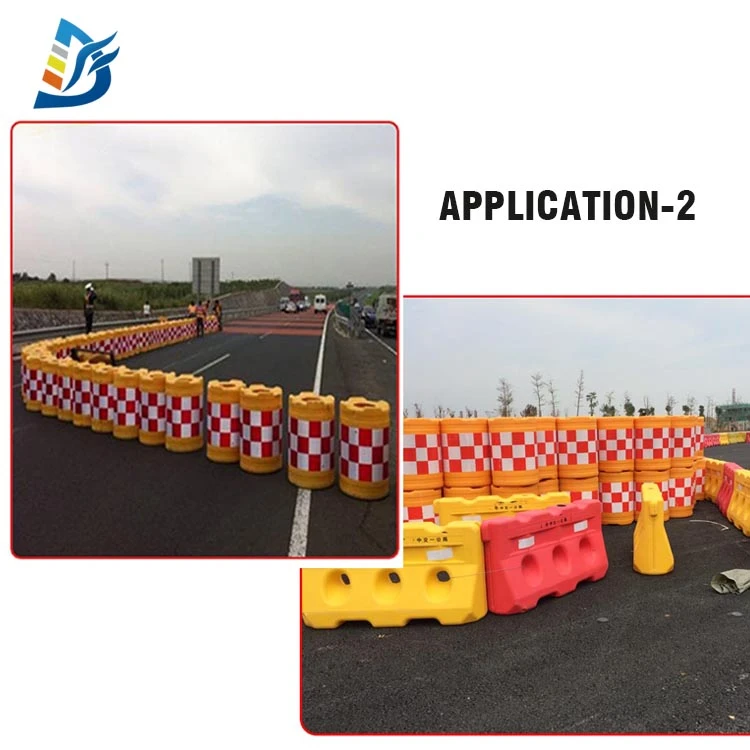
2. Technical Principles & Material Classifications of Reflective Sheeting
Reflective sheeting on road safety barrels operates on the principle of retroreflection-reflecting light to its source regardless of the angle of incidence. The performance, durability, and optical structure of reflective sheeting are internationally classified under standards such as ASTM D4956 (USA) and EN 12899-1 (Europe).
2.1 Optical Technology Categories
A. Commercial & Engineer Grade (ASTM D4956 Type I / Class RA1)
- Optical Structure: Enclosed microscopic glass bead technology embedded in a transparent polymer layer.
- Retroreflective Performance: Low to medium coefficient of retroreflection (RA≈50–70 cd/lx/m2RA≈50–70 cd/lx/m2 for white).
- Service Life: 3 to 5 years of outdoor durability.
- Core Advantages: Budget-friendly, flexible, easy to die-cut and paste on curved surfaces.
- Typical Use Cases: Low-speed residential communities, private parking facilities, commercial garage entrances, temporary indoor construction barriers.
B. High-Intensity Prismatic Grade (HIP) / Microprismatic (ASTM D4956 Type III & IV / Class RA2)
- Optical Structure: Microprismatic technology utilizing miniature cube-corner prisms, or encapsulated glass beads with an air-backed cell structure.
- Retroreflective Performance: High coefficient of retroreflection (RA≈250–360 cd/lx/m2RA≈250–360 cd/lx/m2 for white), approximately 3 to 4 times brighter than Engineer Grade.
- Service Life: 7 to 10 years of outdoor durability with superior UV resistance.
- Core Advantages: High long-distance visibility, excellent contrast in rain and fog, robust scratch and weather resistance.
- Typical Use Cases: Provincial roads, arterial urban roads, standard highway construction zones, temporary lane shifts, intersection medians.
C. Diamond Grade / Super-High-Intensity Microprismatic (ASTM D4956 Type VIII, IX & XI / Class RA3)
- Optical Structure: State-of-the-art "Full-Cube" microprismatic structure where 100% of the surface area contributes to retroreflection with minimal light loss.
- Retroreflective Performance: Ultra-high retroreflectivity (RA≈500–1000+ cd/lx/m2RA≈500–1000+ cd/lx/m2 for white).
- Observation & Entrance Angle: Exceptionally wide-angle performance, ensuring barrels remain intensely bright even when vehicles approach from sharp angles or large vehicles (trucks/SUVs) with higher observation angles.
- Service Life: 10 to 12 years of outdoor durability.
- Typical Use Cases: Highway exits, diverging ramps (gore points), toll booth lane dividers, bridge pier guardrail ends, high-speed work zones.
2.2 Base Film & Adhesive Substrates
Crash barrels are typically rotationally molded or blow-molded from Low-Density Polyethylene (LDPE) or High-Density Polyethylene (HDPE). Polyethylene is a Low Surface Energy (LSE) plastic, which requires specialized backing materials and adhesives:
Top Surface Layer (Film Polymer):
- PMMA (Acrylic): Superior weather resistance, anti-UV, ultra-clear optics, but relatively rigid.
- PET (Polyester): High tensile strength, tear-resistant, cost-effective, ideal for pre-cut chevron bands.
- Flexible PVC / Polycarbonate (PC): High flexibility, conforms smoothly to corrugated and curved barrels without cracking or edge lifting.
- Adhesive System (Pressure-Sensitive Adhesive - PSA):
Must utilize an industrial-grade solvent-based acrylic high-tack adhesive formulated specifically for LSE plastics (PE/PP). Standard sign adhesives will experience edge peeling or bubbling under outdoor thermal expansion and contraction.
How to Choose the Right Reflective Tape for Crash Barrels
Selecting the optimal reflective film requires balancing speed limits, traffic risk levels, environmental factors, and regulatory compliance.
Key Selection Criteria:
1. Match with Road Speed & Observation Distance
- High-Speed Expressways (> 80–120 km/h): Drivers require at least 200–300 meters of advance notice to brake or switch lanes safely. Diamond Grade (ASTM Type XI/IX) is essential.
- Urban Arterials & Suburbs (50–80 km/h): High-Intensity Prismatic (HIP / Type IV) provides the best balance of safety distance and cost-efficiency.
- Low-Speed Roads & Gated Communities (< 40 km/h): Engineer Grade (Type I) or Commercial Grade meets the minimum warning requirement.
2. Match with Road Geometry & Critical Danger Points
- Gore Points / Highway Diverging Areas: These areas experience frequent sudden lane changes and near-misses. Use Fluorescent Yellow-Green / Red-White Chevron bands with Diamond Grade prisms to maximize daytime visual conspicuity and nighttime reflection.
- Toll Booth Plazas & Guardrail Terminal Ends: Constant headlight exposure and dense traffic demand HIP or Diamond Grade with high abrasion resistance.
- Linear Work Zone Guidance: Continuous rows of barrels can utilize Type IV HIP stripes to form an unbroken visual guidance line.
3. Surface Compatibility & Flexibility for Curved PE Barrels
Plastic crash barrels have curved, ribbed contours. Ensure the selected film has:
- High elongation and flex resistance: Prevents micro-cracking along ribbed grooves.
- LSE High-Tack Adhesive: Guarantees adhesion to PE/HDPE plastic without peeling in hot summers or cold winters (−30∘C−30∘C to +70∘C+70∘C).
4. Color Selection & Visual Warning Coding
- Red & White Stripes / Chevrons: Universally indicate physical obstruction, lane closure, or forbidden entry.
- Yellow & Black Chevrons: Indicate hazardous roadside obstacles, bridge abutments, and sharp curve alerts.
- Fluorescent Yellow / Lime Green: High visual impact during dawn, dusk, and overcast rainy conditions, ideal for heavy construction work zones.
Comprehensive Material Comparison Matrix
| Property | Commercial / Engineer Grade (Type I) | High-Intensity Prismatic (HIP - Type IV) | Diamond Grade (Type XI / Microprismatic) |
|---|---|---|---|
| Optical Principle | Enclosed Glass Beads | Micro-Cube Prisms / Encapsulated | Full-Cube Microprisms |
| Coefficient of Retroreflection (RARA) | 50–70 cd/lx/m250–70 cd/lx/m2 | 250–360 cd/lx/m2 250–360 cd/lx/m2 | 500–1000+ cd/lx/m2 500–1000+ cd/lx/m2 |
| Effective Visual Distance | Approx. 80–120 m80–120 m | Approx. 200–300 m200–300 m | Approx. 400–500+ m400–500+ m |
| Angular Performance | Standard | Good | Superior (Extreme wide entrance angles) |
| Weather & UV Resistance | Fair (3–5 Years) | Excellent (7–10 Years) | Maximum (10–12 Years) |
| Substrate Compatibility | High flexibility | Moderate flexibility (Requires pre-curving) | Layered composite (Requires LSE adhesive) |
| Cost Level | 🟢 Low | 🟡 Medium | 🔴 High |
| Primary Recommended Scenarios | Residential gates, parking lots, warehouse paths | Urban roads, provincial routes, standard work zones | Highway exits, toll booths, diverging ramps, high-speed zones |
Practical Installation & Maintenance Best Practices
To ensure maximum reflective performance and avoid premature failure:
- Substrate Preparation: Thoroughly clean the plastic barrel surface with isopropyl alcohol or mild detergent to eliminate release agents, dust, and oil film before pasting.
- Application Temperature: Apply sheeting when ambient temperature is between 15∘C15∘C and 30∘C30∘C. In colder environments, warm the barrel surface with a heat gun to activate the adhesive.
- Firm Pressure Application: Use a rubber roller or felt-edge squeegee from the center toward the edges to eliminate air bubbles and ensure 100% contact.
- Regular Maintenance: Periodically wash barrel surfaces to remove highway grime, mud, and diesel exhaust soot that degrade retroreflective brightness.
Summary
Crash barrels serve as both impact-absorbing cushions and critical visual warning beacons. Selecting the right reflective sheeting grade is directly tied to driver reaction time and accident prevention:
Use Diamond Grade (Type XI) for high-speed, high-risk highway split points and toll plazas.
Use High-Intensity Prismatic (Type IV) as the industry workhorse for municipal roads and standard construction detours.
Use Engineer Grade (Type I) for low-speed residential and parking environments.
Always verify LSE adhesive compatibility to ensure secure bonding on PE plastic barrels across all weather conditions.