What Are The DOT Reflective Tape Requirements For Trucks?
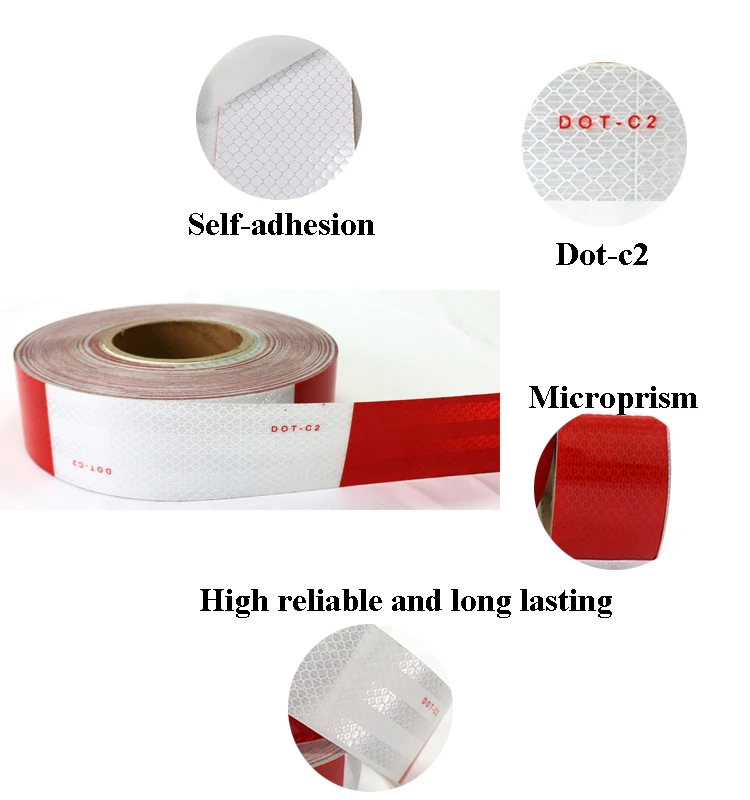
Must use DOT C2 reflective tape
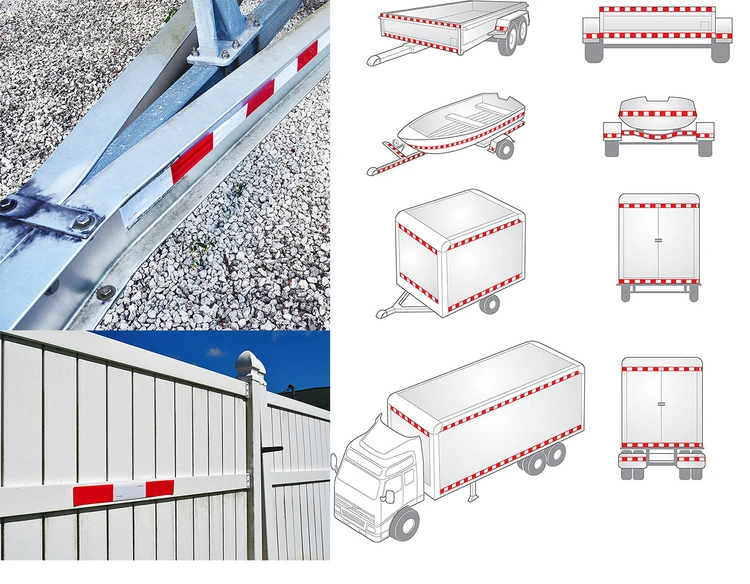
Red and white striped for back and bottom sides of trailers
Silver or white for upper rear of trailers
Must cover at least 50% of total side length
Must be along entire bottom of the back
Must be on the entire lower rear bar
Must have inverted L 12 inches long on upper rear of trailers
Locations For DOT Reflective Tape Conspicuity Treatment
Sides of the Trailer
Rear of Truck
Lower Rear Area of the Trailer
Upper Rear Area of the Trailer
Applying Reflective Safety Tape To The Sides Of The Trailer
The 2″ DOT C2 retro reflective sheeting need to be applied to both sides of the trailer or semitrailer. Each strip of retro reflective sheeting must be positioned as horizontally as practicable, beginning and ending as close to the front and rear as practicable. The conspicuity treatment is not required to be continuous. However, the sum of the length of all of the segments must be at least half of the length of the trailer and the spaces between the segments of the strip must be distributed as evenly as practicable. The centerline for each strip of retroreflective sheeting (or reflex reflector) must be between 375 mm (15 inches) and 1,525 mm (60 inches) above the road surface when measured with the trailer empty or unladen, or as close as practicable to this area. If necessary to clear rivet heads or other similar obstructions, 50 mm (2 inches) wide retro reflective conspicuity tape sheeting may be separated into two 25 mm (1 inch) wide strips of the same length and color, separated by a space of not more than 25 mm (1 inch).
Lower Rear Area Of The Trailer DOT C2 Tape Application
The rear of each trailer and semitrailer must be equipped with retro reflective sheeting (or reflex reflectors). Each strip of retro reflective sheeting (or reflex reflector) must be positioned as horizontally as practicable, extending across the full width of the trailer, beginning and ending as close to the extreme edges as practicable. The centerline for each of the strips of retro reflective sheeting (or each reflex reflector) must be between 375 mm (15 inches) and 1,525 mm (60 inches) above the road surface when measured with the trailer empty or unladen, or as close as practicable to this area.
Conspicuity Tape For Upper Rear Area Of The Trailer
Two pairs of white reflective tape strips of retro reflective sheeting (or reflex reflectors), each pair consisting of strips 300 mm (12 inches) long, must be positioned horizontally and vertically on the right and left upper corners of the rear of the body of each trailer and semitrailer, as close as practicable to the top of the trailer and as far apart as practicable. If the perimeter of the body, as viewed from the rear, is not square or rectangular, the reflective conspicuity tape treatments may be applied along the perimeter, as close as practicable to the uppermost and outermost areas of the rear of the body on the left and right sides.
Rear Of Truck DOT Reflective Tape Applications
On August 8, 1996, the NHTSA published a final rule requiring that truck tractors manufactured on or after July 1, 1997, be equipped with red-and-white retroreflective material similar to that required on the rear of the trailers they tow to increase nighttime conspicuity. Manufacturers may choose either retroreflective sheeting or reflex reflectors. In the case of truck tractors delivered with a temporary mudflap arrangement rather than permanent equipment, the requirement for retroreflective material near the top of the mudflap may be satisfied with material carried by the temporary mudflap brackets that are transferable to the permanent mudflap system. Retroreflective material is also required near the top of the cab in a pattern similar to that used on trailers. (This is a summary of the regulation. For an exact copy of the law you can refer to the actual FMCSA document)