What is DIN 30710? A Comprehensive Guide to Utility Vehicle Safety Markings
In the world of traffic safety and reflective materials, DIN 30710 stands as the authoritative German standard for safety markings on vehicles with special operational rights. Whether it's a street sweeper, a garbage truck, or a road maintenance vehicle, these distinctive red-and-white stripes are engineered to save lives by maximizing nighttime visibility.

The Technical Science of DIN 30710
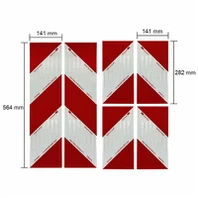
DIN 30710 specifies the color, retroreflective properties, and dimensions of warning markings. The core building block of this standard is the "Normfläche" (Standard Unit), measuring exactly 141 x 141 mm. These units are strategically combined to ensure the vehicle's dimensions are recognizable from hundreds of meters away.
| Standard Component | Dimensions (mm) | Primary Application |
|---|---|---|
| Standard Unit (Normfläche) | 141 × 141 | The modular base for all layouts. |
| Single Unit (Einzelfläche) | 141 × 282 | Ideal for doors and narrow panels. |
| Large Block (Fläche) | 282 × 282 |
Optimized for rear tailgates.
|
The "Inverted V" Layout: Why Direction Matters
A critical aspect of DIN 30710 compliance is the Symmetric Alignment. The stripes must form a "herringbone" or "inverted V" pattern. This visual cue tells other drivers at a glance whether they are approaching the left or right side of a stationary utility vehicle, preventing side-swipe collisions in low-visibility conditions.
Why Choose High-Intensity Prismatic (HIP) Material?
Modern DIN 30710 markings utilize Class RA2 Micro-Prismatic technology. Unlike traditional glass bead films, micro-prismatic materials offer superior wide-angle reflectivity, ensuring the vehicle remains visible even when viewed from sharp angles or under heavy rain.
FAQ
1. How many reflective units are required for DIN 30710 compliance?
A compliant vehicle must feature a minimum of 8 standard units (141 x 141 mm each) on both the front and the rear, totaling 16 units per vehicle to meet legal visibility requirements.
2. What is the standard width for DIN 30710 reflective tape?
The standard width is 141 mm. This dimension is fixed by the German industrial standard to ensure modular consistency across all utility and municipal vehicle types.
3. What do "Style 1" and "Style 2" mean in vehicle markings?
Style 1 (Red-starting) and Style 2 (White-starting) refer to the orientation of the diagonal stripes. They are used in pairs to create a symmetrical herringbone pattern that points outward from the center of the vehicle.
4. Can I use DIN 30710 markings on private cars?
No. DIN 30710 is strictly reserved for utility vehicles with special rights (Sonderrechten) according to traffic regulations, such as municipal service, road construction, and maintenance fleets.
5. What is the difference between DIN 30710 and ECE R104?
While ECE R104 focuses on contour marking (outlining the vehicle frame) for heavy trucks, DIN 30710 specifically addresses warning patches for utility vehicles performing active work on or near public roads.