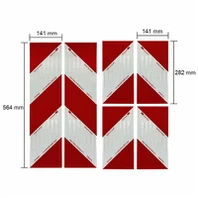
What does microprismatic reflective sheeting and glass bead reflective sheeting mean?
Reflective sheeting is a vital component of road safety measures around the world. These reflective sheets are used on roads, highways, and commercial properties to enhance visibility during low-light conditions. Two types of reflective sheeting that are commonly used are microprismatic reflective sheeting and glass bead reflective sheeting. But what exactly do these terms mean?

Microprismatic Reflective Sheeting
Microprismatic reflective sheeting is a technology that was developed in the late 1990s. The sheets are made by embedding small prisms in a durable plastic film. These prisms are designed to reflect light back to its source, which enhances the visibility of the sheeting.
Microprismatic reflective sheeting is used in a variety of applications, including road signs, barricades, and reflective tape. The sheeting is ideal for use in low-light conditions because it reflects light from a wide range of angles. This means that it can be seen from multiple directions, improving visibility for drivers and pedestrians.

Glass Bead Reflective Sheeting
Glass bead reflective sheeting has been around for much longer than microprismatic reflective sheeting. It was first introduced in the 1930s and is still widely used today. Glass bead reflective sheeting is made from tiny glass beads that are embedded in a reflective layer. Like microprismatic reflective sheeting, glass bead reflective sheeting is designed to reflect light back to its source.
The surface of the glass beads in glass bead reflective sheeting is smooth and rounded, which allows light to be reflected in all directions. This makes the sheeting ideal for use in situations where the light source is likely to be at varying angles, such as road signs and markings.
So Which is Better?

Both microprismatic reflective sheeting and glass bead reflective sheeting are effective in enhancing visibility during low-light conditions. The choice between the two depends on the specific application. Generally, microprismatic reflective sheeting is considered to be more effective in situations where there is no direct light source, such as on barricades, while glass bead reflective sheeting is better suited for situations where the light source is at varying angles, such as on road markings.

In conclusion, both microprismatic reflective sheeting and glass bead reflective sheeting play an essential role in maintaining road safety. By improving visibility during low-light conditions, these reflective sheets help to prevent accidents and save lives.