Understanding DIN 30710:
The Ultimate Guide to Reflectivity for Utility Vehicles
In the utility, municipal, and road maintenance sectors, visibility is a life-saving necessity. DIN 30710 is the critical German industrial standard governing red-and-white warning markings for vehicles with special operational rights.
1. Core Dimensions & Specifications
According to DIN 30710, vehicle markings must be composed of specific standardized units:
| Type | Dimensions (mm) | Composition |
|---|---|---|
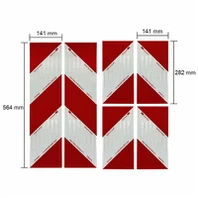
| Standard Unit (Normfläche) | 141 × 141 | 1 Square Unit |
| Single Unit (Einzelfläche) | 141 × 282 | 2 Standard Units |
| Strip Units (Fläche) | 141 × 564 | 4 Standard Units |
2. The "Herringbone" Principle
Minimum Area Requirements
Legislation mandates that both the Front (Vorderseite) and Rear (Rückseite) of the vehicle must feature at least 8 standard units (4 left, 4 right), totaling an area of no less than 0.16 m².
Symmetric Layout
- Style 1 (Red Start): Used on the left side.
- Style 2 (White Start): Used on the right side.
- Visual Goal: The stripes should form an "inverted V" or herringbone pattern pointing outwards to help other drivers perceive the vehicle's width.
3. Ideal Applications
The DIN 30710 standard is essential for a wide range of utility fleets:
- Municipal street sweepers and garbage trucks.
- Utility repair vehicles (Electric, Water, Gas).
- Winter service fleets (Snowplows and gritters).
4. Quality Selection: Class RA2 Reflectivity
For long-term safety, choose reflective films with:
- Class RA2 High-Intensity: For superior wide-angle visibility.
- UV Resistance: To prevent fading for 3-5 years.
- Industrial Adhesive: To withstand high-pressure washing.
Need technical assistance? Contact our team for high-resolution vector schematics or custom installation manuals for your fleet.